Showing posts with label number. Show all posts

Thursday, February 28, 2013

Book Three Project


Chelsea  is a Tragic Hero

When reading the book Speechless, your first thoughts of the main character is that she has to be the antagonist. After all, within pages of starting the book she reveals the secret of a boy she knows, to her whole school for purely selfish motives. She tells everyone that he’s gay and the result of this news, a couple of boys from the basketball team go and beat him up.

I was quick to put her in the villain category because surely there’d be no way for her to recover from this.  After hearing that the boy ended up in the hospital, Chelsea is quick to realize what she’s done. She tells her parents and informs the police what happened and who hurt the boy.

Chelsea decides to take an vow of silence, hoping that it’ll teach her to think before she speaks. The vow causes Chelsea to meet some new friends and through a crazy turn of events be able to right all the wrongs she made.  She even goes as far to apologize to the boy she outted and to give up the life of lies she once led. 

Chelsea fits the description of a tragic hero because she made an error. A huge one. One that almost cost a boy his life. And with all of her old friends against her and some new ones to help her, she realizes her mistakes and tries to make up for them. By the end of the book, she was friends with the boy she hurt and even his boyfriend.

Speechless really taught me that the words you say can have a huge impact on another person’s life. A small blurb of gossip here or a not-so-teasing comment there, can hurt someone. I took a lot more away from this book than I had originally suspected and was happy to have this as my book number 3. 

The story of Chelsea being a tragic hero can be a learning experience for all who read this book

Wednesday, February 6, 2013

Book Project Number 2

13 Reasons Why in Photos

I read the book 13 Reasons Why, where a girl named Hannah Baker creates a set of 13 tapes, each a reason for why she kills herself. Instead of making tapes like Hannah, I created photos, each trying to depict the main reason on each tape which ultimately results in her suicide. 


Without giving too much away about the book, I'll just explain some of the photos that I took.

In the fourth photo, there's a boy peeking in on "Hannah's bedroom" and taking photos. Hannah explains how this guy from school was watching her and taking pictures of her in her own bedroom. The one place she could escape- her room- now felt violated and all of her privacy was gone. 

In the seventh photo, there's a brown bag with Hannah's name on it. In one of the classes she takes, people  put compliments from the day's discussion in the bag to support one another. Someone begins to steal Hannah's notes of encouragement, which leaves her feeling under-appreciated and depressed.

In the final photo, Hannah tries one last time to reach out for help. She talks to one of her teachers and when he doesn't give her the advice she needs, it confirms her choice to end her life.

I thought that since Hannah chose such a creative way to explain her suicide, that I wanted to capture the same things she talks about, just in a different way. The photos are supposed to represent glimpses in to her life of the things that contributed to her death.

Wednesday, December 19, 2012

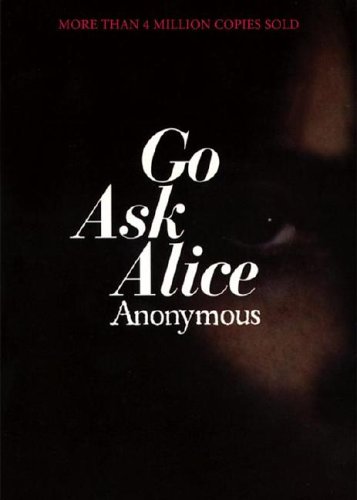
Project Number One - Go Ask Alice

Go Ask Alice: Comparing the book to the movie

I was sitting at home, trying to figure out the best way to do this project when I searched for my book, Go Ask Alice, on Google. I hadn’t realized when starting the book that it was also a movie, but was pleasantly surprised to find that YouTube had the complete movie available to watch. 


The movie was filmed in 1973, just two years after the book was originally published. Being set in this time frame, especially so soon after the book was written, brought it to life. The slang and the diction that could only be found in the ‘70s, made it feel more natural, than if it was filmed today.

The 1973 Movie
Overall, I thought the movie was a very good representation of the book. While it included some parts that the book did not have, I thought they were necessary. For instance, the movie added scenes that really portrayed how much of a struggle it was for someone with a hard core addiction to acid, amongst other drugs, to quit them. I thought the book was lacking this. When reading the book, it seemed that Alice was able to switch on and off her addiction, almost effortlessly. She would have a relapse, leave, then come back and have everything be fine. Never once talking about the emotional difficulty she went through to be off the drugs. I found this unrealistic. The movie also included scenes where Alice talks to a priest. He’s the one who persuaded her to call her parents and go back home. I really liked this scene because it portrayed Alice at her weakest point, and struggling with her inner self on how to survive. The priest, who is played by Andy Griffith, talks to her about calling her parents so she can go home. When she protests, he says, “It’s there or die.” This scene was needed in order to show Alice that if she doesn’t give up acid, she’s going to die. When hearing it as bluntly as Andy put it, it made the difficulty with addiction much more real.

2006 Version of Go Ask Alice
(Another was originally published in 1971)
Like any movie, it was lacking some key points that the book had. The movie was very vague about what happened when Alice took the drugs. While some of the details in the book are vulgar, they’re real and are necessary to the plot. They show just how much drugs change a person and I thought the movie was missing that emphasis. 

The New York Times says, “[Go Ask Alice is] a document of horrifying reality.” Knowing that the book is based on an actual diary, reading the words made you feel like you understood her world and seeing the movie, made you feel like you know her. Despite the fact that both were created over 35 years ago, the things in the book and movie still apply to today. In the end, because of this connection, I found the movie as timeless as the book.